
User-held identity
Profile, private key and approval remain hardware-protected with the person who uses them.
ENTERPRISE IDENTITY
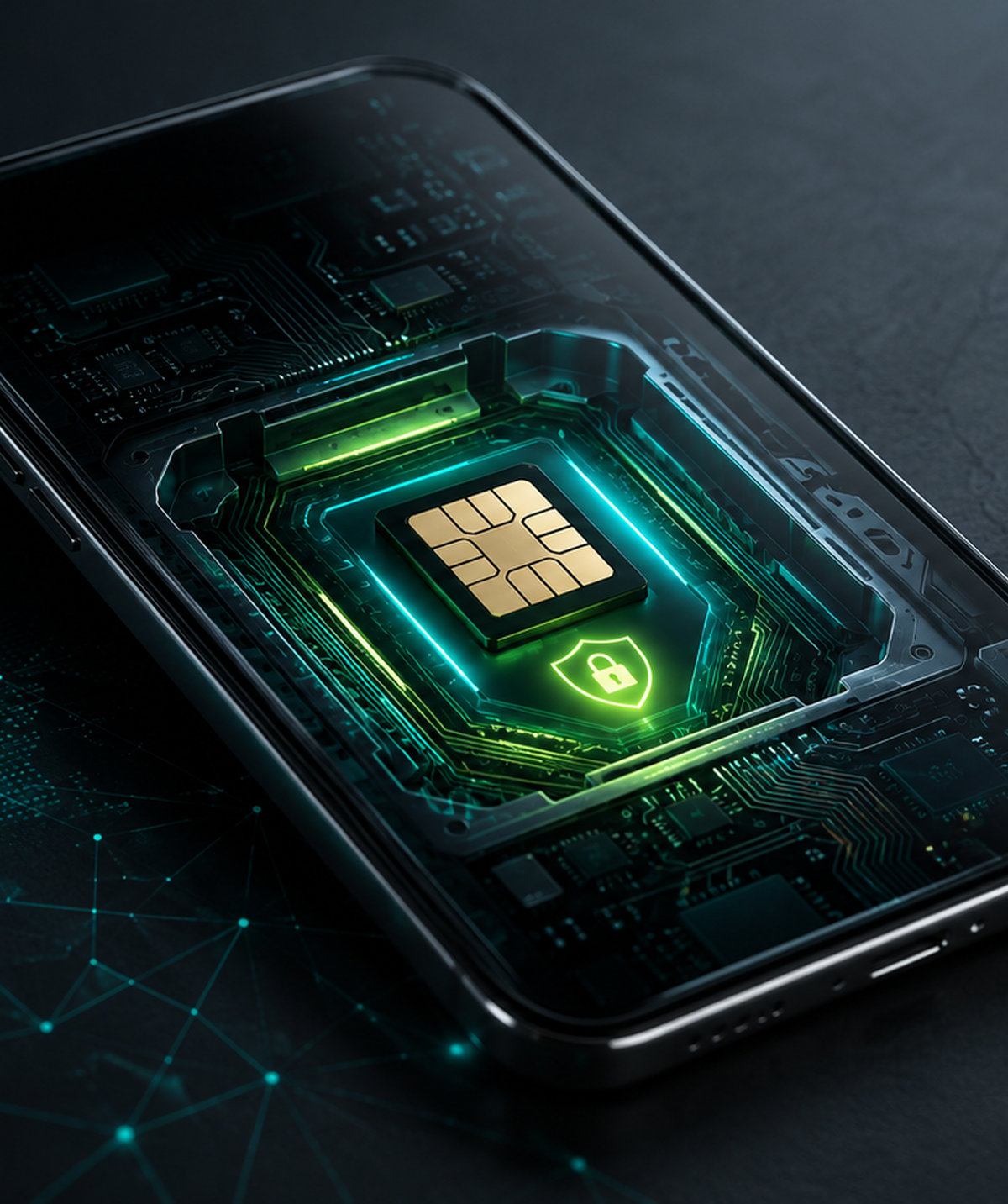
SaferSIM turns the eUICC already inside the employee’s phone into a personal, hardware-backed trust anchor – for SSO and VPN, certificate login and high-security physical access.
THE IDENTITY MODEL
Passwords, PC certificates, VPN tokens and access credentials often live in separate systems. SaferSIM brings the trust anchor into the employee’s phone. Enterprise policy stays exactly where it belongs: with the enterprise.
Profile, private key and approval remain hardware-protected with the person who uses them.
The P-256 key signs inside the eSIM. It is not stored on the PC or in a cloud service.
Service and purpose appear on the phone. The request proceeds only after local SaferSIM PIN approval.
Profiles can be provisioned, rotated, suspended and revoked across multiple access paths.
THREE USE CASES
SaferSIM does not replace your identity or physical-access platform. It adds a hardware-bound approval layer that stays with the employee.
The employee sees the service and purpose, approves locally and returns an eSIM-signed proof. The existing identity platform decides whether access is granted.
Outcome: one auditable approval path for office, home and mobile work.
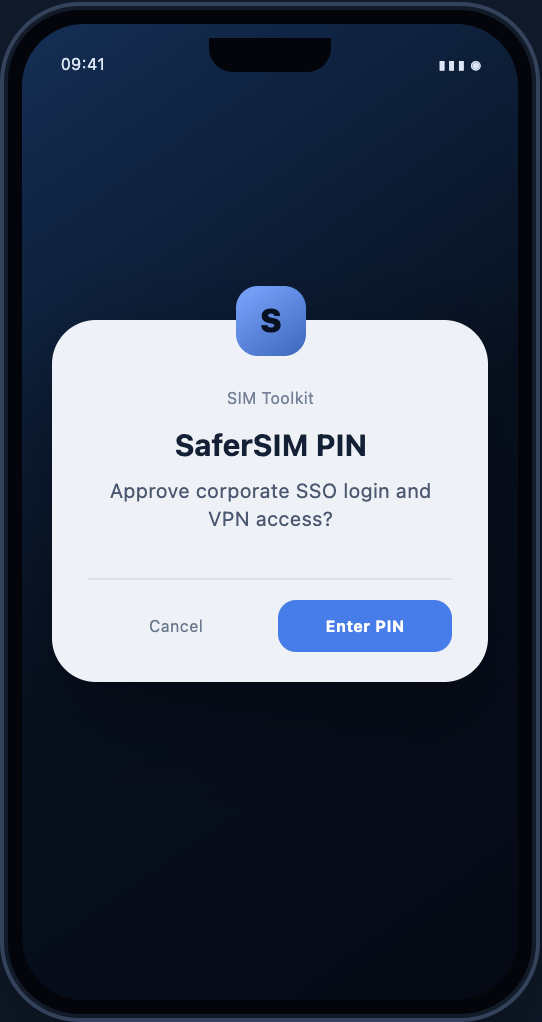

The SaferSIM PC Connector routes the certificate challenge to the phone. The signature is produced by the non-exportable key inside the eSIM.
Outcome: no private key stored on the PC – not even as an exportable file.
A badge or app, local PIN and optional independent face and liveness verification are bound to one access request. The existing PACS still makes the final decision.
Outcome: identity, intent and presence can be combined in one verifiable assertion.

END-TO-END TRUST CHAIN
SaferSIM routes the request to the right profile, protects local approval and returns the signed proof. The connected enterprise system remains the final authorisation point.
SSO, VPN, Entra ID, a PC Connector or PACS creates a challenge with service, purpose and policy context.
The server validates the customer and request, routes the challenge to the right profile and retains audit evidence.
The user sees the context. After local approval, the non-exportable key signs the bound response.
The identity provider, application, VPN gateway or PACS verifies the assertion and remains the final decision point.
TECHNOLOGY & BOUNDARIES
The core path works without an additional authenticator app. Where a richer interface or biometrics are required, an app can be added while the private key remains inside the eSIM.
Protects web and API endpoints with confidentiality, server authentication and transport integrity.
Provides message integrity, replay protection and device proof. The final confidentiality profile is qualified for the selected eUICC and MNO combination.
Protects profile and key loading plus lifecycle operations. This provisioning path is separate from the runtime channel.
Connects SaferSIM to the existing identity and access estate. Enterprise policy remains authoritative.
RECOMMENDED PAID PILOT
We start with the highest-value access path and qualify the exact eUICC, MNO, device, firmware and provisioning combination selected for it.
Request a pilotDefine users, devices, partners and acceptance criteria.
Implement one identity, VPN, PC or physical-access integration.
Check completion, response time, lifecycle, audit evidence and feedback.
Document results, remaining items and the next production scope.

ENTERPRISE 3-PAGER
The 3-pager covers the identity model, three use cases, technical architecture, explicit security boundaries, standards and the recommended pilot scope.
Download the PDFNEXT STEP
Select one workflow. We will align the target system, devices and acceptance criteria and turn them into a pilot scope.
kratz@safersim.com · wulf@safersim.com